A Question That Changes Everything
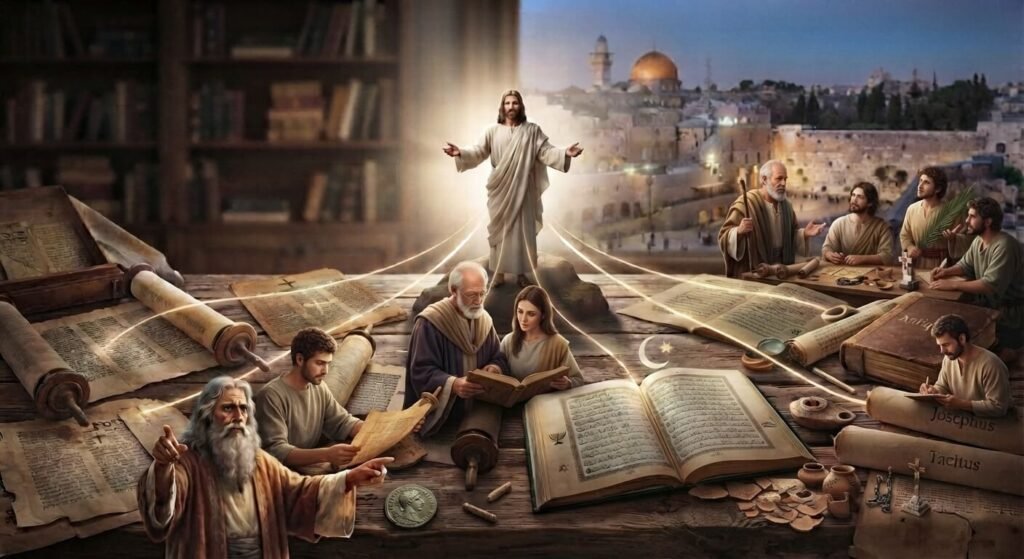
Why, amid the religious and philosophical diversity of the world, do all the sacred books, prophecies, and signs of history seem to converge toward one Person: Jesus of Nazareth? From the Old Testament to the Quran, from historical testimonies to archaeological discoveries, everything seems to point to Him.
This article explores:
- Old Testament prophecies that announced Him hundreds of years in advance.
- Fulfillments in the Gospel that confirm His unique identity and mission.
- The testimony of the Quran about Jesus, a surprising message for many.
- Historical and archaeological evidence supporting His existence and impact.
- The letters of Paul and the testimonies of early Christians, including the martyrs.
1. Old Testament Prophecies: A Precise Portrait of the Messiah
Daniel’s Prophecy of the “Weeks” (Daniel 9:24-27)
One of the most astonishing chronological prophecies in the Bible is Daniel’s prophecy about 70 weeks (490 years) determined for the people of Israel. This prophecy begins with the decree to rebuild Jerusalem (445 BC, Nehemiah 2:1-8) and extends to the coming of the Messiah.
- 69 weeks (483 years) from 445 BC lead us exactly to 30 AD, when Jesus entered Jerusalem triumphantly (Palm Sunday, Matthew 21:1-11).
- The final week (7 years) includes Jesus’ death (which “cut the covenant” with the people, Daniel 9:27) and the destruction of Jerusalem in 70 AD, also prophesied by Jesus Himself (Matthew 24:1-2).
“Know and understand: From the time the word goes out to restore and rebuild Jerusalem until the Anointed One, the ruler, comes, there will be seven ‘sevens,’ and sixty-two ‘sevens.’ It will be rebuilt with streets and a trench, but in times of trouble.” — Daniel 9:25
Other Messianic Prophecies and Their Fulfillments
| Prophecy | Biblical Text | Fulfillment in Jesus |
|---|---|---|
| Born of a virgin | Isaiah 7:14 | Matthew 1:22-23 |
| Birthplace: Bethlehem | Micah 5:2 | Matthew 2:1, Luke 2:4-7 |
| Entering Jerusalem on a donkey | Zechariah 9:9 | Matthew 21:1-11 |
| Betrayed for 30 pieces of silver | Zechariah 11:12-13 | Matthew 26:15 |
| Hands and feet pierced | Psalm 22:16 | Luke 23:33 |
| Crucified among thieves | Isaiah 53:12 | Matthew 27:38 |
| Garments divided | Psalm 22:18 | John 19:23-24 |
| No bones broken | Psalm 34:20 | John 19:33-36 |
These prophecies, written hundreds of years before Jesus’ birth, are fulfilled with astonishing precision in His life, death, and resurrection. The probability of one person fulfilling so many prophecies is astronomical, making Jesus a unique figure in history.
2. The Gospel: Fulfillments That Changed the World
The Life of Jesus: Unique and Unprecedented
Jesus of Nazareth was not just a prophet or a teacher. His life was marked by events that defy human understanding:
- Miraculous birth: Born of a virgin, without an earthly father (Luke 1:26-38).
- Undeniable miracles: Healings, raising the dead, calming the storm (Mark 4:35-41).
- Teachings with divine authority: “You have heard that it was said… but I tell you” (Matthew 5:21-48).
- Death and resurrection: The only One who faced death and triumphed (1 Corinthians 15:3-4).
Jesus’ Prophecies
Jesus not only spoke about Himself but also prophesied about the future of Jerusalem:
- Destruction of the Temple: “Not one stone here will be left on another; every one will be thrown down” (Matthew 24:2). Fulfilled in 70 AD when the Romans destroyed Jerusalem.
- Signs of the times: Wars, famines, earthquakes (Matthew 24:6-8) — history confirms the accuracy of His words.
3. The Quran on Jesus: An Unexpected Testimony
The Quran, the holy book of Islam, speaks of Jesus (Isa) in exceptional terms, recognizing His unique status:
Divine Titles and Attributes
- “The Messiah” (Al-Masih): Surah 3:45, 4:171.
- “The Word of God” (Kalimatullah): Surah 3:45, 4:171.
- “The Spirit of God” (Ruhullah): Surah 4:171.
- “Without sin”: Surah 19:19 (the only prophet described as such).
- “A sign for mankind”: Surah 19:21.
Miraculous Events
- Virgin birth: Surah 3:45-47, 19:16-22.
- Miracles: Healing the blind and lepers, raising the dead (Surah 3:49, 5:110).
- Future judge: “He will be a sign for the Hour (Day of Judgment)” — Surah 21:91.
Comparison with Muhammad
- Jesus is mentioned 25 times in the Quran, with 4 divine titles.
- Muhammad is mentioned 4 times, without divine titles.
- Jesus is the only one who:
- Was born of a virgin.
- Performed miracles (healings, resurrection).
- Will return to judge the world (Surah 43:61).
“The Messiah, Jesus, the son of Mary, was a messenger of God and His word, which He directed to Mary, and a spirit from Him.” — Quran, Surah 4:171
4. Historical and Archaeological Evidence: Jesus Outside the Bible
Non-Christian Historical Testimonies
- Flavius Josephus (37–100 AD) – Jewish historian:
- In “Antiquities of the Jews” (Book 18, Chapter 3), he mentions Jesus as a wise man, who performed miracles and was crucified under Pontius Pilate.
- He also writes about James, the brother of Jesus, who was killed in Jerusalem (Book 20, Chapter 9).
- Tacitus (56–120 AD) – Roman historian:
- In “Annals” (Book 15, Chapter 44), he confirms that Jesus was executed under Pilate and that Christianity spread rapidly in the Roman Empire.
- Pliny the Younger (61–113 AD) – Roman governor:
- In a letter to Emperor Trajan, he describes Christian practices, including worshiping Jesus as God.
Archaeological Discoveries
- Pilate’s Inscription (1961) – Discovered in Caesarea Maritima, it confirms the existence of Pontius Pilate, the Roman prefect who judged Jesus.
- Caiaphas’ Ossuary (1990) – An ossuary discovered in Jerusalem bears the name Joseph bar Caiaphas, the high priest who judged Jesus (Matthew 26:3-4).
- The Dead Sea Scrolls (Qumran, 1947) – A collection of hundreds of scrolls containing:
- Biblical texts (all books of the Old Testament, except Esther) dating from the 3rd century BC to the 1st century AD.
- Messianic prophecies, including Isaiah 53 (the Suffering Servant), which is fulfilled in Jesus.
- Evidence of the precision of biblical text transmission – The scrolls are 1000 years older than the oldest known biblical manuscripts before 1947, proving that the text of the Bible has not changed over the centuries.
5. Paul’s Letters and the Testimonies of Early Christians
Paul’s Letters: The Theological Foundation
Paul, a former persecutor of Christians, became one of the greatest apostles of Jesus after a miraculous encounter with the risen Jesus (Acts 9:1-19). His letters are among the oldest Christian documents (50–60 AD) and testify:
- Jesus as the Son of God: “He is the image of the invisible God, the firstborn over all creation.” — Colossians 1:15
- Death and resurrection: “Christ died for our sins… and was raised on the third day, according to the Scriptures.” — 1 Corinthians 15:3-4
- Salvation by faith: “For it is by grace you have been saved, through faith—and this is not from yourselves, it is the gift of God.” — Ephesians 2:8
Other Early Testimonies
- Clement of Rome (95 AD) – Mentions Jesus’ death and resurrection.
- Ignatius of Antioch (110 AD) – Speaks of Jesus as God and man.
- Polycarp of Smyrna (110–140 AD) – Wrote about Jesus’ suffering.
- Didache (100 AD) – Early Christian manual on baptism and the Eucharist.
- Justin Martyr (150 AD) – Explains how Old Testament prophecies are fulfilled in Jesus.
6. The Blood of the Martyrs: The Supreme Testimony
The early Christians suffered persecutions and death for their faith in Jesus. Their martyrdom became a powerful proof of the truth of the Gospel.
Martyrs of the 1st Century
- Stephen (34 AD) – The first martyr, stoned to death for testifying that Jesus is the Christ and the Son of God (Acts 7:54-60).
- James, the brother of Jesus (62 AD) – Thrown from the Temple wall and beaten to death.
- Peter and Paul (64–67 AD) – Peter crucified upside down, Paul beheaded under Nero.
Martyrs of the 2nd Century
- Ignatius of Antioch (110 AD) – Fed to lions; wrote courageous letters to churches.
- Polycarp of Smyrna (155 AD) – Burned alive at 86; he declared: “Praise be to God, who has granted me the honor to serve Him until this day.”
- Perpetua and Felicity (203 AD) – Torn apart by beasts in the arena; Perpetua left a journal with visions of Jesus.
Impact of Martyrdom
- Growth of the Church: The blood of the martyrs became the “seed of the Church” (Tertullian).
- Courage and faith: The martyrs showed that Jesus is more precious than life.
- Testimony for future generations: Their writings have inspired millions of Christians over the centuries.
7. Conclusion: One Name Above All
If Old Testament prophecies, Gospel fulfillments, the testimony of the Quran, historical and archaeological evidence, Paul’s letters, and the blood of the martyrs all converge toward Jesus, doesn’t He deserve to be known better?
- He is the only One who lived, died, and rose again for us.
- He is the only One who fulfilled hundreds of prophecies with mathematical precision.
- He is the only One recognized as the Messiah, the Word, and the Spirit of God — even in the Quran.
- He is the only One whose existence and impact are confirmed by history, archaeology, and the blood of martyrs.
“For God so loved the world that He gave His one and only Son, that whoever believes in Him shall not perish but have eternal life.” — John 3:16
8. Questions for Reflection
- If Jesus fulfilled so many prophecies and history, archaeology, and testimonies confirm His existence and impact, what does this mean for you?
- Why does the Quran describe Jesus in such elevated terms?
- What would you do if Jesus is truly more than just a man?
