
However, patience is much deeper than the simple ability to wait or to endure something unpleasant. Patience has to do with how a person relates to time, to difficulty, to people, and, above all, to their own process of transformation.
“But let patience have its perfect work, that you may be perfect and complete, lacking in nothing.”
James 1:4
What does it actually mean to endure?
Biblical patience is much deeper than the simple capacity to silently endure a difficult situation, to suffer without complaining, or to wait for things to change.
In the New Testament, the Greek word hypomonē conveys the idea of remaining under a burden, of persevering, and of not giving up when the road gets hard. Patience does not mean being passive, but remaining faithful while going through what God allows in your life.
To endure means to keep loving when it is hard to love, to keep doing good when you see no results, to keep praying when the answer is delayed, and to keep believing when circumstances seem to say otherwise.
Patience doesn’t just change the situation we are going through. It changes us while we go through it.
That is why James says that patience must do its “perfect work”.
Why is it so hard to be patient?
Patience is difficult precisely because it touches two of the strongest desires of our heart: the desire for comfort and the desire for control.
When we have to be patient, we discover that:
- We cannot change the situation immediately, and this strikes at our desire to control.
- We have to live with a tension from which we would like to be freed as quickly as possible.
- We do not know how long the trial will last.
- We do not yet see what God is working behind the circumstances.
The more deeply a situation affects us and the longer we have to bear it, the harder it is for us to be patient.
But that is precisely the point where the shaping of our character begins.
The difference between enduring and being patient
Not every form of “endurance” is patience.
Sometimes we endure a situation just because we have no choice. We grit our teeth, accumulate frustration, and wait for the moment when we can burst, leave, or give up.
This is not the patience to which God calls us.
True patience is grounded in hope.
The one who merely endures says:
“I must hold out until it’s over.”
The one who is patient says:
“God is at work even now. I don’t understand everything, but I choose to remain faithful.”
This is the difference.
Patience does not mean standing still under the burden. It means continuing to walk with God, even when the burden is heavy.
To keep loving.
To keep praying.
To keep forgiving.
To keep doing good.
To keep believing.
What does God produce in us through patience?
1. Patience deepens faith
James says:
“The testing of your faith produces patience.”
James 1:3
Faith is not tested when everything goes well. It is tested when God’s answer seems delayed and when we do not yet see the purpose of the trial.
Then we learn to say:
“Lord, I do not understand, but I trust You.”
Patience teaches us to trust God even when we do not yet see the answer or do not understand what He is doing. As we go through trials and choose to remain faithful, our faith is tested, matures, and becomes increasingly steadfast. Thus, we learn to rely not on what we see, but on God’s character and faithfulness.
2. Builds character
Patience teaches us not to react impulsively, to control our words, and to make decisions wisely. Instead of being driven by emotions, we learn to respond with maturity and remain steadfast even in difficult situations.
3. Brings spiritual maturity
As we go through trials, we learn to look at things from God’s perspective. We no longer look just for quick solutions, but we desire to understand what we have to learn and how we can grow spiritually through every experience.
4. Transforms the way we love
Patience helps us to be more understanding of the weaknesses of others, to listen before judging, and to offer forgiveness instead of condemnation. Thus, we learn to love not only when it is easy, but also when relationships test us.
5. Produces joy and hope
Patience helps us look beyond present difficulties and trust that God can work even in situations we do not understand. Our joy does not come from suffering, but from the hope that God remains faithful and that His work in us has a purpose.
Why can one endure, while another cannot?
One of the answers is hope.
The Bible says:
“We have this hope as an anchor of the soul.”
Hebrews 6:19
A person who has hope can go through a difficult present, because they know that the present is not everything.
If this life were all there is, many sufferings would seem meaningless. But for the one who knows God, the present trial does not have the final word.
There is a God who sees.
There is a God who works.
There is a God who promises.
There is a God who will bring His work to completion.
Therefore, the Christian can say even in the midst of trial:
“I do not see clearly yet what is happening, but I hope in God.”
Another element is identity.
When you know that you belong to God, you no longer have to win every battle, always be right, or be approved by everyone.
You can be criticized without collapsing.
You can be rejected without losing your value.
You can wait without feeling that God has forgotten you.
And, yes, patience is practiced.
Just as a muscle becomes stronger through exercise, character is strengthened through the trials we choose to go through together with God.
Why does patience perfect me?
Because when I endure with God, I am not just going through a difficult situation — God uses that situation to work in me.
The trial tests my faith.
Faith teaches me to trust in Him more.
Trusting in God helps me accept His work in my life.
Accepting His work in my life produces patience.
Patience makes us whole because it touches those areas of our character that comfort would never have touched.
And patience, allowed to finish its work, produces spiritual maturity along with joy.
Therefore, hardship is not necessarily a sign that God has forgotten me.
Often, right in the midst of suffering, God works most deeply.
Not all trials are sent by God, but God can use any situation to shape us according to His will.
And what seems like a burden today can become, through His grace, the workshop in which our character is transformed, to become more and more like that of Christ.
The process by which God perfects us
James presents an extraordinarily clear process to us:
“My brothers, consider it a great joy when you face various trials, knowing that the testing of your faith produces patience. But patience must finish its work completely…”
James 1:2–4
We can see a chain here:
Trial → faith → patience → maturity → perfection.
The entire process must be lived with joy, as the Word of God urges us in James 1:2: “Consider it a great joy when you face various trials.”
Notice something important: James does not just say that we must have patience.
He says that patience has a work to do, and the sign that patience is completing its work is joy.
God does not only want to help us survive trials, but also to use them to transform us into well-trained soldiers who know what they have to do and find their joy in what they do.
Here lies one of the most profound spiritual lessons:
God can use what we want to end to produce in us something He wants to remain for eternity.
We often pray:
“Lord, get me out of this situation.”
And often God answers not by immediately removing the problem, but by changing us in the midst of it.
He works in us while we are waiting for Him to work for us.
Conclusion
Patience perfects me because it teaches me to remain with God even when I do not understand.
The joy James speaks of does not mean that we rejoice in suffering, but that the hope we have in God brings us joy, because we know that everything He does He carries through to completion.
As Paul says:
“I am confident that He who began a good work in you will carry it on to completion until the day of Jesus Christ.”
Philippians 1:6
God does not abandon the work He has begun in us.
Therefore, when you go through a period in which you must wait, forgive, keep going, pray, and remain faithful, do not only ask yourself:
“Lord, when will it end?”
Also ask yourself:
“Lord, what do You want to shape in me while I go through this?”
Because sometimes God does not immediately change the circumstances, but changes the person going through them, and patience is one of the ways through which He matures us spiritually.
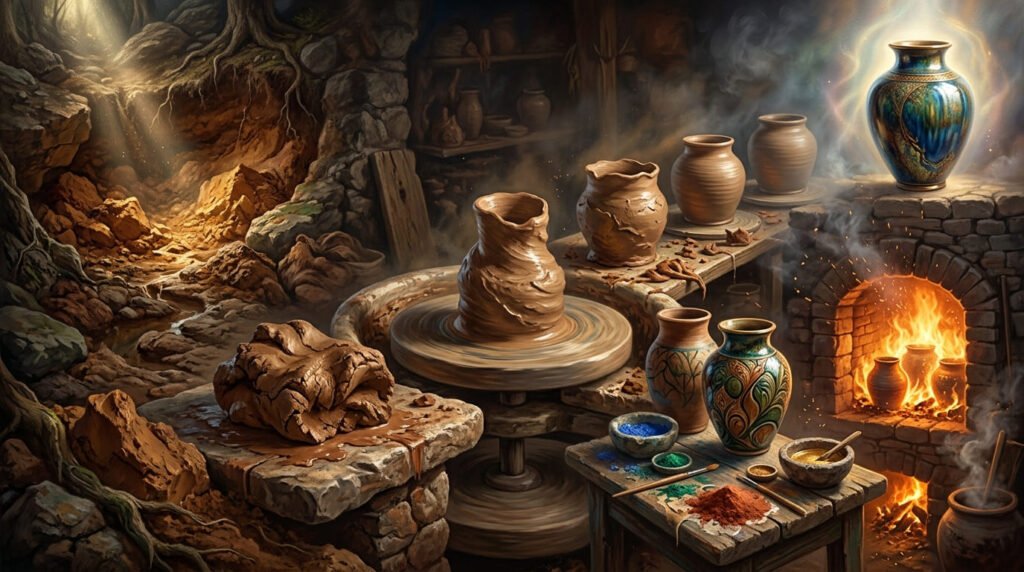
Just as a clay vessel goes through several stages of processing until it becomes a ceramic vessel ready for use, so we also go through various situations and trials in which God shapes us, to become spiritually mature people, ready to fulfill His will.
The question is: What will you choose? Will you accept enduring to get where God wants to take you, that is, to perfection, or will you find reasons to run from His workshop, choosing an easier life at any cost?
