
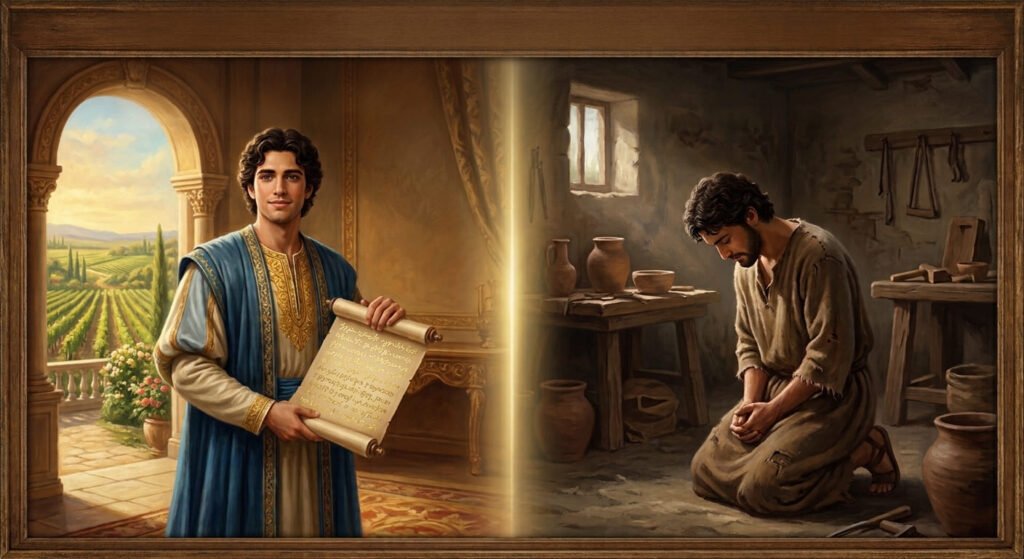
Who am I before God? What is my status and what is my calling on this earth?
These are questions worth keeping with us from time to time, because sometimes, in our spiritual journey, we forget who we are.
God’s Word reveals a truth so beautiful that sometimes it seems almost too hard for us to grasp!
In 1 John 3:1 we read:
“See what love the Father has given us, that we should be called children of God! And that is what we are.”
We are not merely told that we may call ourselves His children, but that we are! How wonderful it is to know that, despite our weaknesses, our falls, and all our limitations, we have a Father who has welcomed us and made us part of His family.
Romans 8:16 tells us that the Spirit Himself bears witness with our spirit that we are children of God.
And Galatians 4:7 adds:
“So you are no longer a slave, but a son; and if you are a son, then you are also an heir through God.”
This is our status: sons and heirs by grace.
And yet, why does Jesus speak to us about being servants?
Here begins such a delicate lesson about life with God.
If we are sons and daughters, why does Jesus seem to reverse the roles?
In Luke 17:10, the Lord says:
“So you too, when you have done everything you were commanded to do, should say: «We are unworthy servants; we have only done what we were obliged to do.»”
What does He mean here?
Here, Jesus speaks about this state of being a servant, without which perfection and attaining the height of the status of a child of God—a status obtained by grace—are impossible.
Jesus – the supreme example of humility
Philippians 2:7-8 tells us:
“But He emptied Himself and took the form of a servant, becoming like human beings. And being found in appearance as a man, He humbled Himself and became obedient to the point of death, even death on a cross.”
Here Jesus offered an example that He Himself first lived out. He left His glory for a time, taking the form of a servant.
From this we understand that this is the only way to attain glory beside Him, through His profoundly true example.
Jesus teaches us that everything we do must pass through this filter: sonship status, but a servant’s condition.
And if we want to truly understand this attitude, we don’t have to look far. We only need to look at Him.
Sonship status, a servant’s heart
Perhaps this is where the two truths we sometimes confuse come together: God gives us the status of sons and daughters, but calls us to keep the heart of a servant, just as His Son did.
We don’t have to choose between being sons and being servants. We’re not talking about two identities that exclude one another, but about two dimensions of our walk with God.
I don’t serve in order to become a son. I serve because I am a son, and this is one of the most beautiful forms of spiritual maturity.
I do not humble myself because I have no worth, but because I have understood the value of the grace that has been offered to me.
Conclusion
What a disturbing and, at the same time, so clear image!
The Son of God chose humility. He to whom all glory is due took the form of a servant. He who could have been served by everyone came to serve.
In John 13, we see Jesus washing the disciples’ feet. A simple gesture, but one that carries a lesson for our entire lives.
If He, the Lord of life, humbled Himself so greatly, what should we do?
And if He chose to take the form of a servant, why would I aspire to anything else?
Therefore, I am an adopted servant, with a humble heart, full of gratitude and hope, because my Master is also my Father.
