
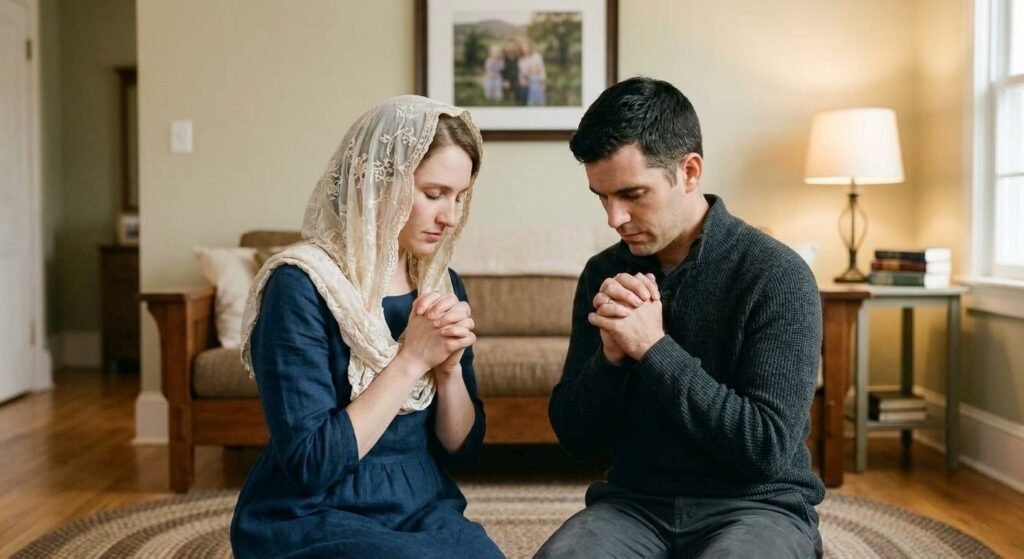
A good many Christians either barely pray at all or pray only when the situation becomes very critical. They wait until they reach a moment of crisis, weakness, or despair to remember that they need God.
This is, in fact, one of the great problems of spiritual life: we remember to pray when we are weak, instead of praying so that we do not become weak.
To better understand this principle, let’s take an example from everyday life.
Think of a car battery. For it to function properly, you don’t wait until it is completely drained before recharging it. The car’s charging system keeps the battery charged continuously. If its charge isn’t maintained, at some point the car will no longer start.
The same is true in our spiritual lives. Prayer shouldn’t be just a reaction to problems, but a way of life. We shouldn’t seek God only when we’ve run out of strength, but also when we’re strong, when things are going well, and when everything seems to be in order.
Unfortunately, many Christians reach a state of spiritual exhaustion, some even a critical state, and by then they can no longer find the strength to pray.
What does the Bible teach us?
In 1 Thessalonians 5:17, the apostle Paul tells us:
“Pray continually.”
We also read in Ephesians 6:18:
“And pray in the Spirit on all occasions with all kinds of prayers and requests.”
If God so clearly urges us to pray continually, that means prayer is not an optional detail of Christian life, but a necessity.
God knows how much we need fellowship with Him. He knows that without a living relationship with Him, we become vulnerable to trials, temptations, and spiritual battles.
What actually happens when we pray?
Prayer has several dimensions, but we can speak of two important aspects:
1. Prayer for ourselves.
We pray for strength, wisdom, guidance, forgiveness, and spiritual power. Through prayer, we draw closer to God, humble ourselves before Him, and learn to depend on His grace.
2. Prayer for others.
We pray for family, brothers and sisters in the faith, the sick, those facing trials, and those who do not yet know God.
But an important question arises: if someone does not pray for their own spiritual life, how will they be able to support the lives of others in prayer?
How will you be able to intercede for your brother if you yourself have neglected fellowship with God?
To be able to bear others’ burdens in prayer, we must first cultivate a personal prayer life. Not because the power comes from us, but because our dependence on God must be constant.
The enemy knows how important prayer is in a Christian’s life. That is why he does everything he can to draw us away from it, keeping us busy with all kinds of things and consuming our time and energy, until we end up neglecting precisely what should be a priority: our relationship with God.
He knows that a Christian who neglects his prayer life becomes increasingly vulnerable.
What should we do?
The answer is simple: don’t neglect prayer, but make it a daily practice!
In Colossians 4:2, the apostle Paul urges us:
“Devote yourselves to prayer, being watchful and thankful.”
We see that the Bible doesn’t just urge us to pray, but to persevere in prayer. In other words, not to give up, not to become discouraged, and not to allow prayer to become an occasional activity that we practice only when we have problems.
Don’t wait for the storm to come before you start praying. Pray when it’s sunny! Don’t wait until you’re sick to seek God. Seek Him when you’re healthy! Don’t wait until you lose your peace to ask for His help. Stay close to Him every day!
When it comes to God’s children, help and deliverance come from the Lord. But think about it: why wait until you reach the end of your strength before asking Him for help?
Philippians 4:6 urges us not to worry about anything, but to make our requests known to God through prayer and thanksgiving.
Prayer is not something to neglect. It must hold a foremost place in the believer’s life, alongside reading God’s Word and fasting.
These three spiritual practices – prayer, the Word, and fasting – help us to cultivate a close relationship with God, based on discipline and dependence on Him
They are not mere religious activities, but means by which we strengthen our relationship with the Lord and prepare ourselves to remain steadfast when the storm grows fierce.
Conclusion
Dear brother, dear sister, don’t wait until you are weak to pray!
Pray when you are strong, so that you may be ready to stand firm in the day of trial.
Pray when you have peace, so that you remain anchored in God when trials come. Pray when you have joy, when you are healthy, when you have resources, and when everything seems to be going well.
Don’t turn prayer into an emergency button that you press only when you have no solution left.
Make it an essential part of your life!
Because storms don’t always announce when they will come, and spiritual preparation doesn’t begin in the middle of the storm, but in days of calm.
Don’t pray only because you need God in difficult moments. Pray because you need Him in every moment of your life!
